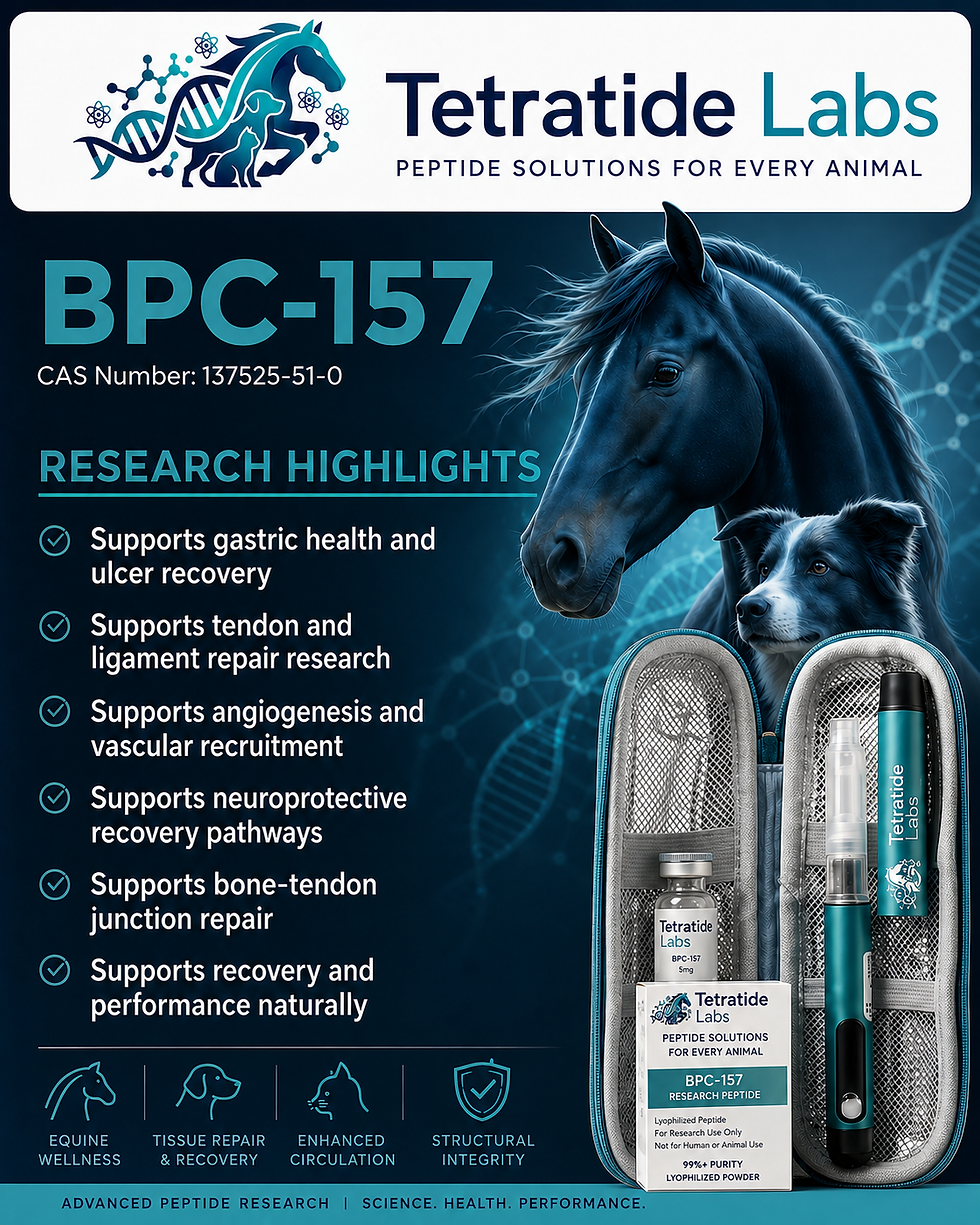
TB500 + BPC157 Wolverine Stack 10mg Vial
BPC-157 + TB-500 Blend
Advanced Peptide Research Formula for Equine & Small-Animal Study Models
Peptide Name: BPC-157 + TB-500 BlendResearch Category: Soft tissue, tendon, ligament, vascular and musculoskeletal repair researchPrimary Research Focus: Equine recovery models, tendon/ligament research, muscle repair, angiogenesis and inflammation modulation
Research Highlights
Equine-Focused Musculoskeletal InterestHorses are highly prone to tendon, ligament and soft-tissue injuries, making this blend especially relevant for equine research models involving connective tissue repair, vascularisation and inflammatory response. Equine literature also confirms that TB-500/N-acetylated LKKTETQ has been specifically monitored in horse plasma and urine because of its claimed regenerative use in performance-horse settings.
Angiogenesis & Blood Flow Support ResearchBPC-157 has been reviewed for angiogenesis-related mechanisms involving VEGFR2, nitric oxide and Akt/eNOS pathways, while thymosin beta-4 has been repeatedly studied for angiogenesis and wound-repair activity.
Collagen, Fibroblast & Connective Tissue PathwaysBPC-157 has shown effects on tendon fibroblast activity, outgrowth and growth-hormone receptor expression in preclinical studies, which supports its research interest in connective-tissue remodeling.
Cell Migration & Tissue Remodeling ResearchThymosin beta-4 is widely studied as an actin-binding peptide involved in cell migration, angiogenesis and wound repair, making TB-500 relevant to research into systemic repair signaling and tissue remodeling.
Product Description
BPC-157 + TB-500 Blend is a dual-peptide research formula developed for veterinary and animal-based research applications, with a strong focus on equine soft-tissue recovery models.
BPC-157, also known as Body Protection Compound-157, is a synthetic pentadecapeptide researched for its cytoprotective, angiogenic, tendon-healing and connective-tissue repair pathways. Preclinical studies have investigated its effect on Achilles tendon healing, tendon fibroblast outgrowth, growth-hormone receptor expression and nitric-oxide-related repair signaling.
TB-500 is a synthetic peptide fragment based on the active region of thymosin beta-4, a naturally occurring peptide involved in actin regulation, cell migration, angiogenesis and wound repair. Thymosin beta-4 has shown strong research interest in vascular repair, dermal wound healing, angiogenesis and inflammatory modulation.
Together, this blend is positioned as a multi-pathway research formula for studying soft-tissue repair, vascular recruitment, collagen remodeling and musculoskeletal recovery signaling in animal models. The blend is especially suited to research involving horses, where tendon and ligament injuries are a major area of veterinary and performance-animal study.
Researched Areas & Benefits
1. Tendon & Ligament Repair Research
BPC-157 has shown promising preclinical results in tendon-healing models, including transected Achilles tendon research and tendon fibroblast studies. This makes it particularly relevant to equine research, where superficial digital flexor tendon and suspensory-type soft tissue injuries are common areas of study.
2. Muscle & Connective Tissue Recovery
BPC-157 has been investigated across multiple musculoskeletal tissues, including tendon, ligament, muscle and bone-related repair models. TB-500’s thymosin beta-4 pathway adds research relevance through actin regulation, cell migration and tissue remodeling.
3. Angiogenesis & Vascular Recruitment
Both peptide pathways are strongly associated with angiogenesis research. BPC-157 has been linked with VEGFR2 and nitric-oxide-related vascular mechanisms, while thymosin beta-4 has demonstrated angiogenic and wound-healing activity in peer-reviewed models.
4. Inflammation Modulation
Thymosin beta-4 has been studied for anti-inflammatory activity in dermal and wound-healing models, while BPC-157 reviews describe broader cytoprotective and inflammatory-pathway research interest.
5. Systemic Repair Signaling
TB-500 is researched through its relationship to thymosin beta-4, which plays roles in cytoskeletal organization, cell migration and vascular repair. This gives the blend a broader research profile beyond localized connective-tissue repair.
Equine Research Positioning
This product is especially relevant for research involving:
Tendon and ligament repair models
Equine soft-tissue recovery research
Muscle-fibre remodeling pathways
Angiogenesis and blood-flow support research
Collagen and fibroblast activity
Post-injury inflammatory response studies
Veterinary regenerative-medicine research models
Important note: The strongest evidence is still largely preclinical. There is not yet robust peer-reviewed clinical evidence proving a direct BPC-157 + TB-500 “synergistic” effect in horses. The blend is best described as a mechanistically complementary research combination, not as a proven veterinary treatment.
Technical Information
BPC-157 Chemical Name:Gly-Glu-Pro-Pro-Pro-Gly-Lys-Pro-Ala-Asp-Asp-Ala-Gly-Leu-Val
BPC-157 CAS Number:137525-51-0
TB-500 Chemical Name:N-Acetyl-Leu-Lys-Lys-Thr-Glu-Thr-Gln
TB-500 CAS Number:885340-08-9
Format:Lyophilized peptide vial
Purity:99% purity
Use Category:Research use only
Kit Includes
1 × BPC-157 + TB-500 Peptide Vial
1 × 10ml Sterile Water
1 × Reconstitution Kit
Regulatory Notices
SAHPRA DisclaimerThis product has not been evaluated by the South African Health Products Regulatory Authority. It is not intended to diagnose, treat, cure or prevent any disease.
Research Use OnlyFor laboratory, veterinary research and analytical study purposes only. Not for human consumption. Not for therapeutic veterinary use unless under the direction of a qualified professional and in compliance with applicable regulations.
Competition Animal NoticeTB-500 and related thymosin beta-4 fragments are monitored in equine sports and have been the subject of equine doping-control research. This product should not be used in competition animals without confirming all applicable rules and withdrawal requirements with the relevant governing body.
Scientific References
Regeneration or Risk? A Narrative Review of BPC-157 for Musculoskeletal Healing
A 2025 review describing BPC-157’s preclinical musculoskeletal repair pathways, including angiogenesis, fibroblast activity and nitric-oxide-related signaling.
Gastric Pentadecapeptide BPC-157 Accelerates Healing of Transected Achilles Tendon in Rats
Preclinical Achilles tendon research showing accelerated healing activity in a tendon-injury model.
BPC-157 Enhances Growth Hormone Receptor Expression in Tendon Fibroblasts
Study showing BPC-157 increased growth-hormone receptor expression in tendon fibroblast research.
Thymosin Beta-4 Accelerates Wound Healing
A widely cited study investigating thymosin beta-4 in wound healing and angiogenesis.
Thymosin Beta-4 Promotes Angiogenesis, Wound Healing and Tissue Repair
Research supporting thymosin beta-4’s role in angiogenesis and wound repair pathways.
Doping Control Analysis of TB-500 in Equine Urine and Plasma
Equine-specific study confirming detection of TB-500/N-acetylated LKKTETQ and metabolites in horse plasma and urine after administration.